
Land your next .NET job role with these helpful resume tips

Let's be honest. It can be frustrating and sole-destroying when applying for a .NET and C# developer job role, particularly if you don't hear a squeak from the company you applied for.
With the emergence of artificial intelligence (AI) in the past 18 months, it has meant that companies have made record number of redundancies for software and web developers. And that means that more candidates are fighting over one job.
However, there are some simple tweaks you can make to your resume or CV that can make you stand out from the rest of the crowd and get that all important job interview. And these tips will help even if you have little to no experience in the industry.
Does your resume have the correct keywords?
If you are applying for a .NET web developer role, and your resume does not contain the terms "C#", ".NET" and "ASP.NET Core" anywhere, it's very unlikely that you are going to hear back from any company.
Companies can be subjected to hundreds, maybe even thousands of applicants for one job role. Therefore, they need an automated system to filter out applicants that don't meet the criteria.
An application tracking system (ATS) is something that is used by companies to do just that. It can be used to filter out candidates that reside in a country where the company is unable to employ. It can also be used to filter out candidates that are not qualified for the role.
Think about it. If a company is looking for a ASP.NET Core Web API developer with Entity Framework and SQL Server experience, they are going to be looking for resume's that contain the words "ASP.NET Core", "Web API", "Entity Framework" and "SQL Server" before they even consider an interview.
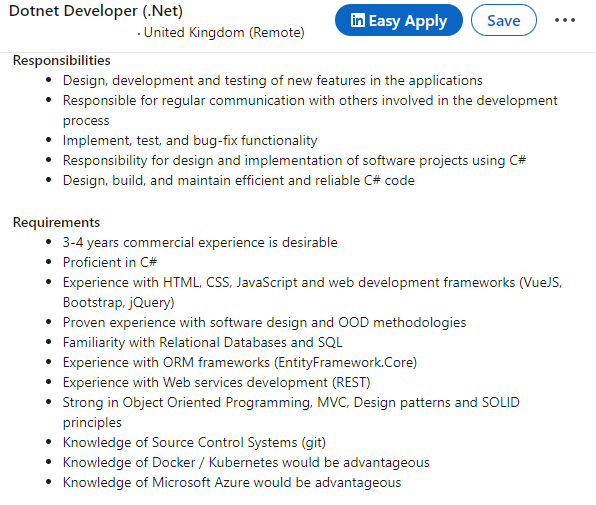
You should be able to see what skills are required by looking at the job description. Assuming you are qualified for the role, try to add as many keywords into your resume that the job role is looking for.
A mix of technologies
Do you have a bit of experience with WordPress? Java? Perl? PHP?
It's good to show off all your skills in a resume, but I have some news for you. Recruiters are not technical people! Not all of them know that there is a difference between PHP and Java.
By including all the technologies that you know, you run the risk of being contacted by recruiters for jobs that you don't really want to do, or are not really qualified for. And that's frustrating for both parties!
Therefore, we need to make life as easy as we can for the recruiter. This is where you want to think about your perfect role.
Would you prefer a .NET developer role working on Web API's, Entity Framework and SQL Server? Or would you prefer a front-end developer role?
Taylor your resume around the perfect role that you want to do and that you're best qualified for and avoiding adding technologies that you have limited interest in. If you're doing a bit of Angular in your current role but hate it, don't add it to your resume! You can always mention it in the interview if you're lucky to get one.
Lengthy resume's
Is your resume three pages long? Four pages long? Maybe more? You need to cut it down to a maximum of two pages! Maybe even one?
As mentioned before, companies can be subjected to many resume's for one job role. Recruiters and hiring managers do not have the time to go through massive essays to decide on whether you might be a suitable candidate for the job.
Here are some tips to cut down lengthy resume's:
Personal information
If you are applying for a job through LinkedIn or a company website, the chances are you have to fill out personal information like your mobile number and your email address. So ask yourself if you really need this on your resume as well?
Irrelevant information like hobbies
Have you added what you get up to at the weekend? What hobbies you do in your spare time? As nice as it is to put a bit of personal touch into your resume, a recruiter or hiring manager is not going to be a slight bit interested in what your favourite food is as it's not related to the job that they have are trying to fulfil.
Unrelated jobs
You may have a cleaning job on the side? Or maybe you fix cars at the weekend to earn a little bit of extra cash? That's all good, but if you are applying for a .NET developer role, these jobs aren't related and therefore they do not have to be on a resume.
Consider which jobs to showcase
If you have been in the industry along time, or have been jumping between jobs every two to three years, there is potential to put down everything about these jobs.
However, you are limited on space. Therefore, it's best to put down the jobs that are relevant to the job that you are applying for. Remember, you've got a maximum of two pages!
Mentioning that you worked for a company that used classic ASP with a Microsoft Access database between 2006 and 2007 is not going to be relevant when applying for a .NET job in today's market.
Personal traits and buzzwords
We are all "hard-working", "passionate" and "organised", but these are just buzzwords that bloat a resume.
You can show off your true personality if you are lucky enough to get an interview. For a resume though, it's just words without actions and therefore is going to add very little to you getting a job interview.
Education
Unless your education is relevant to the job you are applying for, than consider whether it's worth adding?
If you have a degree in Computing and you are looking for your first job, then it's definitely worth adding. But if you have 15 years of experience, it's not going to add anything to your resume.
Likewise, if you have a qualification in English and Maths, that's not really going to add much value to the resume and therefore doesn't need to be included.
Layout
Is there too much white space between each job? Is the font too big? Consider what changes you can make to the layout to reduce the space.
Uploading your resume to job sites
This is particularly important is you are currently out of work and looking to find a .NET job quickly.
Have you uploaded your resume to any job sites? Here are some that you can upload them to:
Recruiters can look over your resume on these job sites and get in contact with you with any relevant jobs.
And with LinkedIn, you can even share your resume in a post!
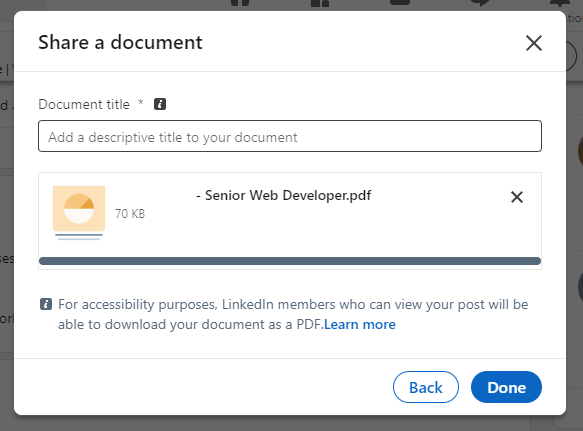
Just a word of caution with these method. If your resume is well written and you are qualified for many of the jobs that are on offer, you may be overwhelmed with the responses you get from recruiters. This can be particularly tricky if you are currently in a job and you don't want your current employer to know that you are looking for new opportunities.
Side projects
If you have little to no experience in the industry, this is important. Recruiters and hiring managers are under extreme pressure to get the right candidate for the job that they are looking to fulfil. Therefore, you'll need to be able to show off your current .NET and C# knowledge in an interview.
And what better place to think about it then to add your side projects it to your resume.
Do you have a blog, a GitHub account, or a YouTube channel? Or do you make regular contributions on StackOverflow?
Don't be shy! Add these to your resume and it could be the difference between getting an interview or being ghosted.
Personalise your resume for each role
Different companies are looking for different skills. One company may prefer for you to work on Web API's. Whilst another might want you to spend your days working with Blazor.
When applying for a job, have a look at your resume and compare it with the job description. Is there anything in the job role that isn't included in your resume? Maybe there is stuff in your resume that isn't relevant for your role?
Make a separate copy of your resume and make it so it's suitable to the job that you are applying for.
Watch the video
Watch our video where we show you how you can share your resume in a LinkedIn post, and talk you through how to go can through a job description and see if you qualified for the job that is advertised.
Now to get the interview
Even with these changes, there are still going to be companies that you'll never hear back from. And this could be for a multiple number of reasons:
- An internal employee has been successful in fulfilling the role.
- The job role has been pulled due to financial restraints.
- You're not qualified for the job role.
- Overwhelming number of candidates for that particular role.
The list goes on! Don't get too disheartened and keep at it. Try to apply for as many suitable job roles as you can.
Even if you get an interview, still keep looking for jobs.
Just because an interview went well doesn't mean you are going to get an offer. You don't want to put all your eggs in one basket.
Related pages

